


The Martin Beck Theatre Becomes a Home for Actors and Playwrights

The theater establishes itself with large-scale productions and intimate, serious drama.
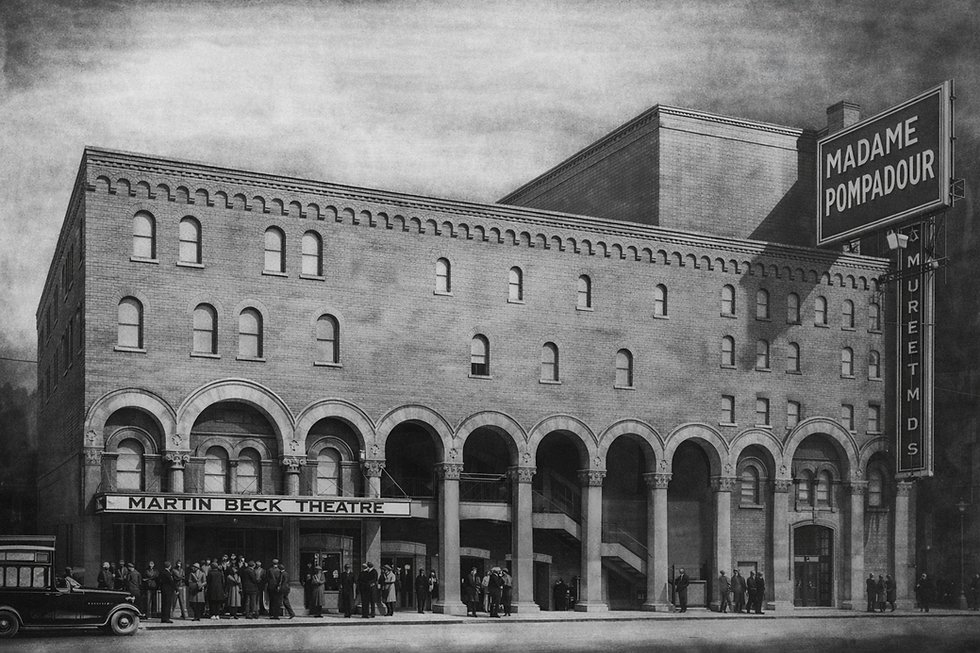
Though Martin Beck passed away in 1940, there are those who believe that he never actually left his theater. Performers and staff have reported seeing a lone, dark figure—sometimes described as a man in a three-piece suit—in the balcony or in a box seat. He sits there quietly, watching rehearsals or performances with intense focus. And this presence became even more active after 2003, when the theater’s name was changed from "Martin Beck" to "Al Hirschfeld". Longtime staff say Beck would have hated that—and that his continued presence in the theater is his way of protesting the removal of his name from the marquee. After all, he built the place, put his name on it, and made sure everyone knew exactly who was in charge.

Out front of the theater, there is still a small box office window that bears the name “Martin Beck.” And to this day, some staff will acknowledge it as they pass—both out of ritual and respect—as if keeping that name in place might keep him at peace. And maybe it worked. Because unlike more mischievous ghosts sighted in other Broadway theaters, his presence here is often described as "soft" or "admiring" as he simply refuses to leave the theater he loved.
And to be honest, Beck never really did leave. Not just in name, but in everything and everyone that followed him. The playwrights who brought their work there. The actors who performed on stage. The productions that arrived with such hope and promise. All of it happening in the same space, one after another, year after year. And over time, those moments don’t disappear—they build upon one another and continue to grow.
That is the story of the Martin Beck Theatre—not defined by a single production or person, but rather by a constant cycle of risk, reward, and reinvention. So let's explore some of these playwrights and actors and musicals, and even the flops that shaped not only his theater but the American stage as well.
“Welcome to Season 3 of Closing Night, a theater history podcast that dives into the stories of Broadway's famous and forgotten shows that closed too soon. I'm Patrick Oliver Jones, a Broadway actor and award-winning podcaster based in New York City. This season, I’ll be your guide as we focus on the Martin Beck Theatre—who this man was and the legacy he left on Broadway. You’ll hear firsthand accounts of those involved in the theater’s productions, revealing just how unpredictable and unforgiving the path to Broadway can be."
THE ARTISTS
Martin Beck opened his theater with a musical spectacle that was meant to show off the grand design and scope of his new Broadway house. One that was built for scale and flexibility and made almost anything possible—large casts, massive sets, productions that pushed beyond what other stages could handle.
In 1930, for example, audiences walked into the theater and saw something they had never seen before—a full-size battleship floating onstage. It wasn’t a backdrop. It wasn’t a suggestion of a ship. It was built to scale and engineered to move and shift inside a massive tank of water that filled the backstage area. The production was called Roar China!—a Soviet drama presented by the Theatre Guild. The play featured a cast of more than eighty performers, most of them Chinese actors recruited from New York’s Chinatown to bring a level of authenticity rarely seen at the time. This was the kind of spectacle most Broadway houses simply couldn’t support. But the Martin Beck could.
Now, of course, not every play needs a full-size battleship. Beck was just as interested in smaller, intimate productions as well . He understood that theater was always a balancing act between art and economics—something that playwright George Bernard Shaw knew all too well. His play The Apple Cart had premiered at the Beck the same year as Roar China. Here is what Shaw told The NY Times:

“I have to think of my pocket, of the manager’s pocket, of the actors’ pockets, of the spectators’ pockets, of how long people can be kept sitting in a theatre without relief or refreshments ... I have to consider theatrical rents, the rate of interest needed to tempt capitalists to face the risks of financing theaters, the extent to which the magic of art can break through commercial prudence ... in short, all the factors that must be allowed for before the representation of a play on the stage becomes justifiable.”
In other words, what was said onstage had to survive what it cost to put it there. So while the Beck Theatre would still host large-scale productions, over time it became just as known for the intimate drama. Works that relied less on spectacle and more on language, ideas, and artists who could bring these stories to life. Through the decades, the Beck became a proving ground for some of the most remarkable creatives of the 20th century—writers, actors, composers, directors—each having their own unique experiences at the Beck that would become milestones in their careers.
One of the earliest examples was playwright Eugene O’Neill, who arrived at the Martin Beck Theatre for the first time in 1929 with his play Dynamo. By this time, he was already widely regarded as America’s leading playwright, with three Pulitzer Prizes to his name. But success came at a cost. Throughout the 1930s, O’Neill gradually withdrew from New York and moved to California—in search of privacy, better health, and the space to write without constant public pressure. It was during his time away that he finished one of the most ambitious plays of his career, The Iceman Cometh. But with World War II being waged across Europe, he held off having the play produced, as he explained in a letter to a friend:

“The Iceman Cometh would be wrong now. A New York audience would neither see or nor hear its meaning. The pity and tragedy of defensive pipe dreams would be deemed unpatriotic…But after the war is over, I am afraid from present indications that American audiences will understand a lot of The Iceman Cometh only too well.”
While O'Neill had always explored dark themes, Iceman was more complex and abstract than his earlier works. This one was a long, heavy, four-act drama set in a rundown saloon, where a group of drifters clung tightly to what they called their “pipe dreams.” These fragile illusions kept them going until one day a traveling salesman named Hickey arrives and forces them to confront the truth.
O’Neill held on to this story and waited 7 years until the time was right. And he finally agreed for the Theatre Guild to bring his work to the Beck in 1946. And with it, the reemergence of a towering figure, who had largely been absent from the American stage for almost a decade. He brought with him longtime collaborator Robert Edmond Jones to do scenic and lighting design. Eddie Dowling was chosen to direct. Earlier that year, he had directed, produced, and starred in the original production of The Glass Menagerie. So this was quite a shifting of the gears for Dowling.
And from day one, it was intense, and one of the biggest points of contention was the length of the play. Coming in at almost five hours, both Dowling and the Theater Guild pressed O’Neill to edit and reduce the script, but he stood his ground and wouldn’t yielded. At one point, one of the producers pointed out that a specific sentiment was repeated 18 times and suggested some cuts. O’Neill famously replied, "He intended it to be repeated eighteen times!". He even left a note for that producer that simply said, "To hell with your cuts.”.

So the rehearsal process was a mix of creative tension but also mutual respect, and the demands on the actors was just as relentless. The sprawling ensemble of 20 actors led by James Barton had to sustain a constant presence of quiet desperation, even in silence, while navigating deliberately repetitive dialogue meant to reflect the characters’ stagnant lives. And at the center of it all was Barton in the role of Hickey—carrying the emotional and physical weight of the play, culminating in a long, psychologically exhausting monologue that lasted about 16 minutes at the end of the play.
There’s one interesting story from rehearsals that blurred the line between performance and reality. This is when O’Neill, Dowling, and the cast walked to lunch in full costume. Along the way, they were joined by actual vagrants who mistook them for fellow drifters. When they got to the pub, the owner tried to throw them all out, but O’Neill spoke to the man and insisted they all be served together. That kind of raw authenticity defined the production. But it also led to O’Neill gradually and begrudgingly relenting and making some cuts to various conversations and backstories throughout the play, much to the surprise and delight of Dowling and the producers.

Iceman Cometh opened October 9, 1946. O’Neill stood in the backstage wing watching the curtain rise to a round of applause from an enthusiastic audience. At that point, he left through the backstage door and never again set foot in the Beck Theatre. Over the course of the ensuing months, audiences would feel the same. The pessimism of this production was a hard pill to swallow for some, especially in the immediate aftermath of World War II. With its dense subject matter, repetitive dialogue, and a runtime of almost 5 hours, reception from critics and audiences was decidedly mixed, and the show lasted only 136 performances. But as producers always do, the Theatre Guild offered a different reason for the closing:
“As it was, The Iceman Cometh had a considerable run, and one which I think would have been much longer had not James Barton developed a case of laryngitis, so that it became increasingly difficult to hear him during the latter part of the play…we finally arranged to have him leave after the New York run, when the part was excellently played by E. G. Marshall. As we had to continue to pay Mr. Barton's salary under our contract with him, this placed a heavy financial burden on the undertaking. However, while this experience was unfortunate, it was nevertheless not such as to affect the magnificent quality of the play and the high place it occupies in the catalog of O'Neill's work.”
The Iceman Cometh won the Award for Best American Play in 1947 from the New York Drama Critics’ Circle. But for the most part this production was considered a failed return for O’Neill. it really wasn’t until its off-Broadway revival ten years later that The Iceman Cometh would be recognized as O’Neill’s most profound work.
It just goes to show how theater is constantly shifting and reassessing—artistically, financially, and culturally. And the Martin Beck Theater was certainly ready and willing to take on those risks, not just with established playwrights like O’Neill but newcomers as well.

In 1961, a young 29-year-old composer named Jerry Herman made his Broadway debut with Milk and Honey—the first Jewish-centered musical on Broadway—opening three years before Fiddler on the Roof. Set in Israel, the story follows a busload of lonely American widows touring the country in hopes of finding new husbands, and it starred legendary Yiddish theatre comedian Molly Picon in her first English-language Broadway musical. And joining her were the legit voices of Robert Weede and Mimi Benzell from the NY Metropolitan Opera. Before writing the score, though, Herman spent time traveling through Israel to form an authentic backbone for his compositions. However, he found that tougher than he imagined.
“That was also a tremendous problem for me, because when I got to Israel I heard American rock and roll. I heard some Arabic wailing. I heard everything but what I thought Israeli music, you know, was supposed to sound like. So I had to create a sound that I thought the American public would buy as Israeli music, and i went to the Polish-Russian charters. I went to this sort of thing ... which I used, you know, in the show and that was inspired by my having heard Russian folk songs and Polish. And it really is not Israeli, and no one knew it at the time, but i'm telling you the truth it was not Israeli.”
Milk and Honey began its pre-Broadway tryout in New Haven, Connecticut in August 1961. It was also the first time Herman had ever heard his music with orchestrations. He came from the musical revue world with just a piano, maybe some bass and percussion. So hearing a full 28-piece orchestra was a glorious experience for him. He would later say, “It was astonishing. I went through a box of Kleenex. It really hit me.”
Well, that first night in Connecticut hit the audience as well. The applause for Picon was so deafening at the end of her song “Hymn to Hymie” that director Albert Marre said to Herman, “Why don’t we put her trademark somersault at the end of her number?” Herman agreed but asked what that had to do with the song. To which Marre replied, “We’re a musical comedy, we can do what we want.” So they let Picon do her signature somersault, which only made the audience go crazier, and it remained for the rest of the run.

The company moved on to the Colonial Theatre in Boston, before finally coming to New York, playing one preview, and opening the next night October 10th. Critics loved the story and admired the score, with The NY Times praising its rapturous quality and youthful energy: “A heartwarming integrity shines through Milk and Honey, which arrived last night at the Martin Beck Theatre. An endearing asset in any theatre work, it is remarkable in a musical.”
After one of the evening performances, Helen Hayes came backstage to congratulate her. Picon joked that she was often called “the Yiddish Helen Hayes.” To which Hayes smiled and responded, “And I’ve been called the shiksa Molly Picon.” This moment captured something about the show itself—warm, affectionate, and proudly rooted in Jewish culture. And despite its niche subject matter, the production earned five Tony Award nominations, including Best Musical and Best Composer. It ran for 543 performances before closing in January of 1963, launching the Broadway career of a composer who would go on to write classics like Hello, Dolly! and La Cage aux Folles.


Just a few years later, Louise Heim Beck had sold the theater, and Jujamcyn was now the sole owner. For their inaugural production the went with playwright Edward Albee, for the premiere of his ninth play A Delicate Balance. The story centers on a wealthy suburban couple whose orderly lives begin to fracture as friends and family invade their home, bringing with them a quiet but suffocating sense of dread. But finding actors for the leads proved to be more difficult that expected.

Producer Richard Barr initially approached legendary actors Alfred Lunt and Lynn Fontanne, whose demands ultimately proved too restrictive. Other high-profile casting options followed before the roles finally settled on Jessica Tandy and Hume Cronyn—a real-life husband-and-wife duo whose dynamic brought an added layer to the material.
But once the cast came together with director Alan Schneider, rehearsals were notoriously difficult. Albee’s dialogue, and its precise rhythms and stylized structure, challenged the actors, while Schneider’s stern approach created a tense and uncomfortable working environment. The play itself offered little physical action, unfolding instead through language and psychological tension, which led some reviewers to describe it as static or even inert. And yet, that stillness was intentional. Albee wasn’t interested in traditional drama—he was exploring the quiet erosion of meaning in modern life—as he later explained to Charlie Rose, describing what he hoped audiences would take away from his play:
“We have to remember that no two people see the same play, I mean you have an audience of 1000 there, that's 1,000 different plays, because no two people bring the same intelligence, the same sensitivity, the same willingness to be affected...And so, no two people see the same play. What I want to happen is that maybe they will relate what they've seen on the stage to themselves, rather than to their friends of course and maybe they will change in some way. Maybe learn a little bit of something about waste, about not living your life fully.”

A Delicate Balance met with deeply divided critical reception. Some hailed it as a brilliant examination of modern angst, while others dismissed it as hollow, talky, and derivative. But reviewers took special note of Marian Seldes and her ability to convey disturbing spiritual distress through her physical performance and a deep understating for Albee’s cryptic dialogue. With all its challenges, the production lasted 132 performances and was nominated for five Tonys, including Best Play, but Seldes was the only win for Best Featured Actress.
However, the following year Albee would receive his most significant recognition when A Delicate Balance was awarded the 1967 Pulitzer Prize for Drama—the very first in Albee’s career. It also marks one of two Pulitzer-winning plays ever staged at the Beck. The other was John Patrick’s The Teahouse of the August Moon, which opened in 1953.
And there’s another layer to this story: Edward Albee was the adopted grandson of Edward Franklin Albee I—the same man who ran the Keith-Albee Circuit and took the Palace Theatre away from Martin Beck. However, Beck may have had the last word. While the Palace did become a celebrated cinema and concert venue, it would take 50 years before it finally became a Broadway house. In the meantime, Beck’s theater was becoming a home for some of the most influential writers of the American stage. But no matter how powerful the writing may be, a script doesn’t come to life on the page—it only find its voice through the actors who bring it on the stage. But finding the right actor can be its own journey.

In the mid-1970s, Meryl Streep was still making a name for herself in New York theater—and doing so at a remarkable pace. In a span of just two years, she appeared in four Broadway productions, earning a Tony nomination and multiple Drama Desk nominations along the way. And it was in 1977 that she took on what would become her fifth and final Broadway role, appearing at the Martin Beck Theatre in a musical called Happy End.

Although it was billed as a “new” musical, Happy End actually began fifty years earlier. Composer Kurt Weill and playwright Bertolt Brecht were riding high on the success of The Threepenny Opera and wanted to write a follow-up, so they came up with a musical satire set in Chicago that pits a gang of criminals against the Salvation Army. And the happy end is when the criminals and Salvation Army members join forces against the evils of capitalism. When it premiered in Berlin in 1929, however, the musical sparked protests and near-riots in the theater, leading it to close after just two days.
And it would be another 40 years before critic and dramaturg Michael Feingold brought it out of obscurity, creating a new English adaptation. He worked alongside director Michael Posnick, and together they mounted their new version at Yale Repertory Theatre—where graduate student Meryl Streep first became involved with the show.

After Yale, producer Michael Harvey took the lead and wanted to bring the show to Broadway. The problem was Harvey had a reputation for short-lived productions—like The Grass Harp, which had closed at the Beck Theatre after just seven performances. So there was already some question as to whether Happy End would live up to its name. Harvey’s original plan to take the show out of town never materialized. Instead, he took it off-Broadway in March of 1977 to the Chelsea Theater Center. And that is when things really start shifting.
Christopher Lloyd replaced the lead actor, Posnick was out as director, and the leading actress Shirley Knight left the show for artistic reasons. That’s when they brought back Meryl Streep—who by now was a Broadway regular. But as she explained in this radio interview, stepping into the production was anything but simple:
STREEP: Well I came in the back door sort of…(laughing) I mean to Happy End, to the musical because I replaced someone when it was still at Chelsea before we moved to Broadway…I was just finishing The Cherry Orchard, and I came in and did it, and I think I had three afternoons to rehearse it and then we started previews. And then we moved to Broadway.
DICK SEFF - How did they know you could sing? You haven’t sung before in New York on the stage.
STREEP - No, but I kind of—I’ve always wanted to do it, and I kind of insinuated that I would be interested if everybody approached me, since they were losing their leading lady. So somebody heard and got wind of it, and said, ‘Sure come on down!’

But after Streep joined the cast, the production suffered another setback when Lloyd severely injured two ligaments in his leg during a performance. His understudy, Bob Gunton, took over the role and finished the run at Chelsea. And then, some unexpected good luck came along.
Just two weeks earlier, another play at the Beck Theatre—Ladies at the Alamo—had opened with high expectations. But it was quickly panned by critics and closed after only 20 performances. So now the Beck was suddenly available. And with the Tony eligibility deadline just days away, Harvey orchestrated a remarkably quick turnaround—transferring the production to Broadway just one week later, skipping previews entirely and opening on May 7, 1977.

With Lloyd still out, Bob Gunton started the Broadway run, but the very next day came down with the measles and had to leave the show. So, the following day, Lloyd was back, performing on a pair of crutches. As it turned out, by the end of the run, he had grown fond of the crutches and felt they actually improved the character. But for Clive Barnes of The NY Times, the performance of the show came from Meryl Streep, calling her a “knock‐out” and that “she alone would make Happy End worth seeing.”
Unfortunately, though, not many people were seeing it, and the musical struggled at the box office—closing on July 10, 1977 after just 75 performances. But the ending of this show marked a new beginning for Streep. Just three months later, she made her film debut in Julia and never again returned to Broadway.

For the Martin Beck Theatre, Happy End was just one in a long string of unsuccessful shows. It got so bad that some in the industry began to call the stage “cursed.” That’s because during the 1970s, two productions closed after a month, two more were gone within a week, and two others didn’t even make it past opening night.
THE FLOPS
When Martin Beck built his theatre, he understood that every new show was a gamble. And over the decades, his stage has seen its fair share of Broadway casualties. But some of them didn’t just fail—they vanished almost immediately. One of the earliest examples comes from an actress who knew a thing or two about failure.

Katharine Hepburn was just 21 years old actress when she made her Broadway debut at the Martin Beck Theatre in 1928 with Night Hostess. Over the next few years, she worked steadily, appearing in a string of original plays—mostly in supporting roles—but none of them made much of an impression. At one point, she even went on as an understudy in Holiday, but later admitted the performance fell completely flat, as she tried to just imitate the leading actress instead of trusting her own instincts. Critics weren’t kind either, complaining about her “shrill voice” and what they called an “objectionable manner.” But in 1932, everything changed.

Hepburn landed the leading role in The Warrior’s Husband at the Morosco Theatre. During its three month run, a Hollywood talent scout happened to see the show and invited her to do a screen test for an upcoming RKO film directed by George Cukor. Well, she landed that role, and the following year was a whirlwind of success for her—appearing in four films and winning an Academy Award for Best Actress. But even with this sudden Hollywood stardom, Hepburn still wanted to make her mark on the stage.
So when Broadway producer Jed Harris reached out to her, she saw this as a golden opportunity. By 1933 Harris had 14 Broadway credits to his name, including The Royal Family and The Front Page. However, it was widely known how difficult it was to work with him. That same year, Walt Disney released The Three Little Pigs, and Harris was said to be the inspiration for the Big Bad Wolf—within theatrical circles that nickname stuck, using it to describe his volatile, huffing-and-puffing personality.

However, things between Harris and Hepburn seemed promising at first. Telegrams between the two show Harris enthusiastically courting her for the lead role in a British play called The Lake. It tells the story of a young woman who goes into a loveless marriage to escape an overbearing mother, only for her husband to die in a car accident immediately after their wedding. (Pretty grim, huh?) Despite being offered a relatively low salary, Hepburn eagerly accepted. But before rehearsals began, legendary actress Helen Hayes offered a warning: ‘Don’t let Jed direct you. He will destroy your confidence.’ A prediction that would turn out to be ominously accurate.

Because in the middle of rehearsals, Harris abruptly fired the original director and took over staging himself. For the rest of the rehearsal process, Harris became increasingly demanding—criticizing Hepburn’s every move. His harsh directing style did in fact break her down, and Hepburn struggled to find her footing in the role. But when the production began tryouts in Washington, DC in the fall of 1933, ticket sales were strong with massive interest in seeing a Hollywood star return to the stage. The reviews noted that the young celebrity was greeted with a whirlwind of applause—with critics generally more impressed by Hepburn’s vivid stage presence than the play itself.
However, the reality check came when the show moved to the Martin Beck Theatre on December 26, 1933—notably without additional rehearsals or even a preview process. New York critics saw the D.C. success as just unearned celebrity worship, and were much harsher in their reviews of opening night—describing her voice as a "rather strident instrument" and noting she lacked the "flexibility of first-rate acting.” But it was legendary theater critic Dorothy Parker who delivered the most famous line of the night. During the intermission, Parker remarked to others in her party: “Well, let’s go back and see Katharine Hepburn run the gamut of human emotion from A to B.” Unfortunately, audiences agreed. And Hepburn knew it. Years later, she would describe her performance this way:

“Laid an egg in The Lake and was the joke of this city….I just walked through the opening night, petrified, petrified…I mean, Dorothy Parker said, and quite correctly, she ran the gamut M-U-T-T-T-T-T of emotion from A to B. And I just said, well, she never landed on B. She just got as far as A. And that was it.”
As box office sales plummeted, Hepburn had to endure the embarrassment of playing to evermore empty seats. Mercifully, the show closed in February 1934 after just 55 performances. Yet surprisingly, Harris announced he planned to move the production to Chicago. When Hepburn protested, he told her bluntly, “My dear, the only interest I have in you is the money I can make out of you.” Well, with that she wanted out, so she offered Harris every cent she had in her bank account—almost $14,000—to buy her freedom. (That’s about $334,000 today.) So, Harris got his money, and shut the production down. Years later, Hepburn would call Harris “hands-down the most diabolical person I have ever met.” But the experience taught her a crucial lesson: from that point on, she would take control of her own career:
“Well, the secret of life is how you survive failure, isn't it? Yeah, sure. You gotta be tough.”

But not every failure at the Beck Theatre rested on the shoulders of a performer or a difficult director. Sometimes, the gamble was based on the entire music catalog of one composer. In 1939, just a year before Martin Beck passed away. Susanna, Don’t You Cry was part of a repertory season presented by the newly established American Lyric Theatre. The company chose Beck’s theater specifically because it was one of the few Broadway houses with a stage large enough to accommodate opera-style productions with complex staging. And Beck, as the only theater owner in New York without a mortgage, had the freedom to host experimental groups like the ALT and focus on artistic value over commercial appeal.

As part of a six-show season, Susanna, Don't You Cry was a large-scale musical built around the songs of Stephen Foster—considered to be the ‘Father of American Music.' It used his familiar melodies like ‘Oh! Susanna’ and ‘Camptown Races’ to frame a romantic story. In many ways, this was like an early version of what we now call a jukebox musical—and we all know how hit-or-miss those can be. But by the time this one reached Broadway, it was already out of date. The show leaned heavily into operetta and minstrel styles of storytelling that audiences found tired and old-fashioned. Broadway was shifting more toward modern, integrated musicals, and this felt like a step backward.
Critics weren’t impressed either, Time magazine said that “it had a plot which died of Southern molassitude.” Even with its massive cast of 83 performers filling the stage, there wasn’t much to hold it all together. Sure, the songs were familiar, but the story never gave them much reason to be there—and audiences didn’t stick around to find out. In total, Susanna was one of three flops in this collection of shows. And within days, the entire repertory season collapsed, and with it, the American Lyric Theatre itself—shutting down completely after just a dozen performances. While most flops don’t usually take down entire theater companies, they can still crash and burn just the same.
Next, we have a medieval tragedy that turned into a modern-day disaster. The Lovers opened in 1956, starring Joanne Woodward and Darren McGavin, and was written by Leslie Stevens, who was just 31 years old with this his second play on Broadway. It told the story of a warlord invoking an ancient right to claim a peasant bride on her wedding night—setting off a chain of events that ends in violence and heartbreak. The play was staged by Michael Gordon, a veteran director who had been blacklisted in Hollywood and was rebuilding his career in theater. And he certainly had his hands full with this production.

Rehearsals were dominated by the sheer physics of the production. He had to move more than 40 actors across a complex, rotating unit, so much of the creative time was spent on traffic control rather than character depth. It truly was an epic tale wirth an even more epic production, yet the critics were completely taken with it. Newspapers around the city called it "Brilliantly pictorial." "Eloquent and colorful." "Enormous ingenuity." and "An impressive work of art."
I mean, the show had a huge cast and a multi-level set designed to accommodate 48 different scenes. So yeah, it was impressive to watch, but it was also expensive to produce. And while critics may have praised it, there were still complaints about “narrative confusion" and "lack of humor" from outlets like The New Yorker. And without unanimous praise for a tragic and grim drama set in the 12th century, the production struggled to find an audience among casual theatergoers, and ticket sales fell flat. So producers made the choice to close The Lovers after just four performances, but the play's quick failure allowed Woodward to transition much earlier into her renowned film career.

One of the more puzzling flops, though, came in 1965 with Drat! The Cat!—a musical comedy with an unusual name about a society girl secretly living a double life as a jewel thief. It starred a young Lesley Ann Warren and featured Elliott Gould as the detective trying to catch her.
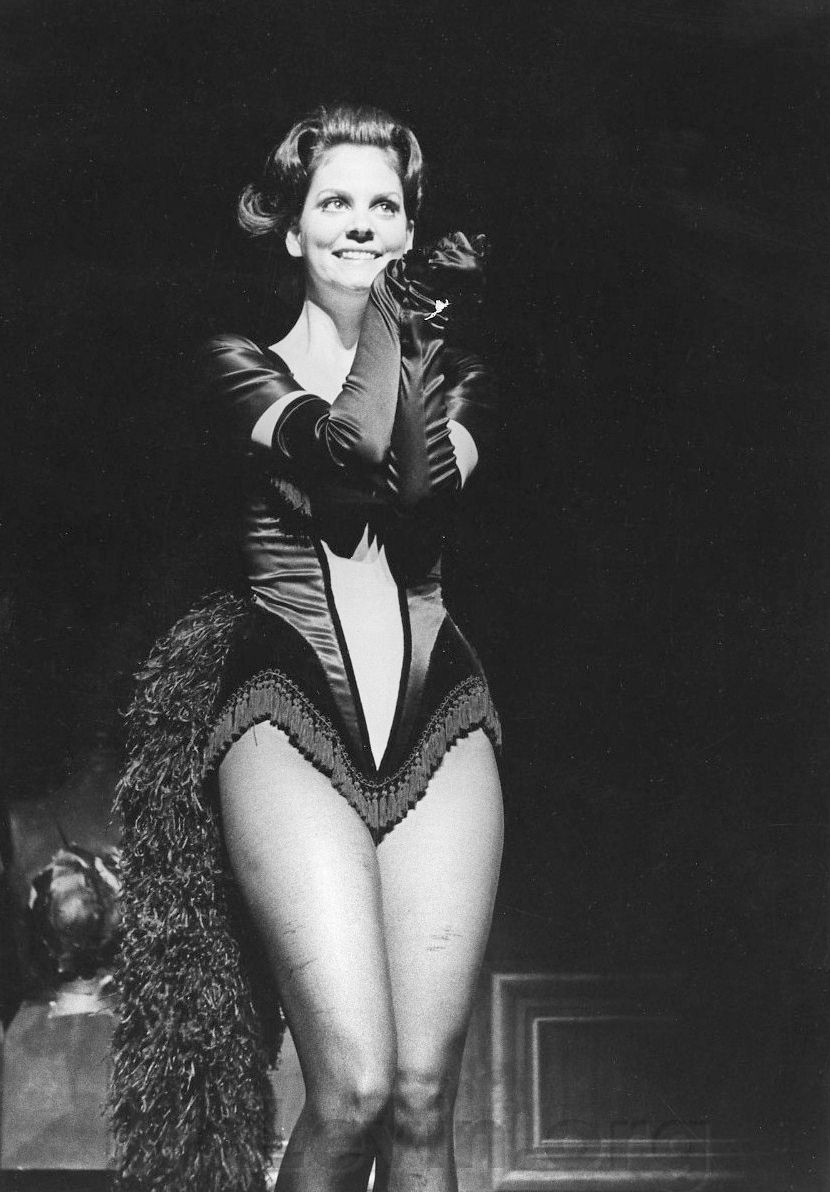
On the surface, it had all the makings of a hit: A playful, offbeat premise. A cast full of strong performers. Direction and choreography by Tony-winner Joe Layton. And a lively, tuneful score, that—based on a live cast recording--had audiences laughing and applauding throughout. And though some critics called it a little daffy and over-the-top, the performances were largely praised—and it even earned a Tony nomination for Best Scenic Design.
But ultimately, it had some big obstacles to overcome: There was a city-wide newspaper strike which meant advertising was non-existent, first-time producer Jerry Adler hadn’t raised enough money and the show arrived in New York virtually penniless. But the biggest hurdle was that the show opened in the same season as The Odd Couple, Kismet, Oliver!, and Roar of the Greasepaint - The Smell of the Crowd. So with shows like that to choose from, would you go see Drat! The Cat!? No—and neither did anyone else.
The show barely lasted a week, closing after just eight performances.The musical is perhaps best remembered today for the song "He Touched Me," which became a major hit for Barbra Streisand. Its "cult flop" status among musical theater fans also led to a 1997 studio recording and various regional revivals, including a West Coast premiere by The Group Rep just last year. But not every flop gathers a following after it closes.


As I mentioned, the 1970s were a rough time for the Martin Beck Theatre, and at start the 1980s things weren’t doing much better. The Beck had already closed five shows in just 19 months. But it still continued to bring important stories to the stage—this time focusing the life of Jackie Robinson, the first man to break Major League Baseball’s color barrier in 1947. So naturally the musical was called The First, and hopes were high at the end of 1981 that this production could finally be a home run.
Martin Charnin, best known as the creator of Annie, was the driving force behind the show—with film critic Joel Siegel writing the book and Robert Brush brought in to write music, both of them making their Broadway debuts. However, the demographic of this particular creative team made Brush be a little hesitant at first—questioning if three white guys should take on such an iconic figure in Black history. To which Charnin simply replied, “It’s going to be great.”

Also, Charnin felt that being Jewish, he could bring some empathy to what Robinson had gone through and that by writing The First, he could tell the story with understanding and awareness. Be that as it may, it should also be noted that there were several Black artists involved with the production, such as the director, music supervisor, associate choreographer. Even Jackie Robinson’s wife was a consultant on the project, and gave her blessing after watching a run through of the show.
Now, most Broadway musicals usually go through a development process of months or even years, Charnin opted to not have an out-of-town tryout and instead go straight to Broadway. So in October 1981, they moved into the theater. But by this time stage manager Peter Lawrence noted that Charnin has basically lost faith in the book and was not that collaborative throughout the process.

However, as previews began Charnin asserted his control over the show as one of the actors was fired and Joyce Brown, the music supervisor, was let go. These changes led to a longer preview process and delayed the opening by five days. But by opening, the show featured a strong cast led by a young David Alan Grier, making his Broadway debut as Robinson. His performance quickly emerged as one of the show’s bright spots, along with the superb baseball sequences. Despite several strong reviews, Charnin later pointed put, the production missed the one review that truly mattered at the time—that of New York Times critic Frank Rich. Here’s what he had to say about the musical:

“If you're going to do a musical about how Jackie Robinson broke the color barrier in major-league baseball, there are two very difficult tasks that must be done right: you must find a singing actor who can impersonate the charismatic Robinson of legend, and you must find a method for simulating baseball games on stage. The paradox of ‘The First,’ which opened at the Martin Beck last night, is that both these tough demands have been met well—and that the more routine tasks of creating a musical haven't been met at all. While this show offers about five minutes of good baseball and a promising star in David Alan Grier, its back is broken by music, lyrics, book and direction that are the last word in dull.”
There had been plans in place to record a cast album the day after opening, but that was canceled due to the poor reviews, and the musical struggled to find an audience. In fact, during the final two weeks of the run, ticket sales averaged about 250 a night—in a theatre that seated 1,200. The show closed December 13, 1981 after just 31 performances. Grier would later say “life had been perfect for those few months.”

But then, fast forward six month later, The First would surprisingly receive three Tony Award nominations—Best Book, Best Direction, and one for Grier as Best Featured Actor. Though there were no wins for the production, Grier used the momentum from his Tony-nominated performance to quickly move into the original off-Broadway production of A Soldier’s Play and eventually become a replacement in the hit musical Dreamgirls, playing James Thunder Early.

And now we come to the 1985 revival of Take Me Along—which may be one of the most intriguing flops in Broadway history. It tells the story of a middle class New England family with teenage children who are coming of age, falling in love, and desperately trying to stay out of trouble. And the original 1959 production of this turn-of-the-century family musical was a huge hit, starring Jackie Gleason, and was nominated for 9 Tony Awards, including Best Musical.
So when it arrived at the Martin Beck 25 years later, it had a proven track record. And being based on a play by Eugene O’Neill, the show had pedigree as well. Original composer Bob Merrill and book writer Joseph Stein even reunited to write new material and songs for this revised production. And their work paid off. The show spent seven months on the road, gathering rave reviews and strong momentum at each step. It first opened at the Goodspeed Opera House in Connecticut:
“The show stands up as a worthy piece of 1950's Americana. It could hardly be better served than by the Goodspeed's handsome, deftly paced resurrection.”
From there it went on to the Shubert Theatre in New Haven, and then to the Kennedy Center in Washington, DC: “The whisper around Kennedy Center is that its chairman, Roger Stevens, saw the Goodspeed production of Take Me Along and fell in love with it, booking it quickly into Kennedy Center on impulse without elaborate preparations. The next time Mr. Stevens has an impulse like this, Kennedy Center audiences may say Take Me Along again.”

So by the time it reached Broadway, it was a sure thing … until it wasn’t. What had played so well out of town was suddenly seen as bland, underpowered, and more like a “skimpy summer stock production” than a Broadway revival. UPI called the show awkward and embarrassing, noting this cast lacked the star power of the original, and as if delivering a final blow, “the period costumes show more inspiration than the rest of the physical production.”
And on a stage as large as the Martin Beck, that kind of thin production had nowhere to hide—the sets looked sparse, and the show simply couldn’t fill the space. And with zero advance ticket sales, there was no chance to recover. Take Me Along closed after 7 previews and just one performance. As Ken Mandelbaum put it: "It was simply a case of a well-received, small-scale regional production that wasn't strong enough to withstand Broadway exposure.”

...but then, two months later Kurt Knudson who played Uncle Sid Davis in the show received a Tony nomination for Best Featured Actor. Now, while it might seem shocking that a show which closed on opening night could receive a nomination, it had more to do with an historic lack of competition rather than the quality of the production. In fact, the 1985 Tony Awards had so few shows to pick from, that the Tony nominating committee actually eliminated three major award—Best Actor and Actress in a Musical as well as Best Choreography—so it was a lean year for productions. All that to say, Knudson did not win—but his nomination remains one of the strangest footnotes in Tony history.
THE FINAL CHAPTER

But that is the nature of Broadway—there’s no guarantee any show will last. But in the 1980s, it wasn’t just productions that were at risk. The theaters themselves were, too. Following a wave of demolitions in 1982, which I talked about in the first season, New York City moved to protect its remaining Broadway houses. In 1987, the Martin Beck Theatre—along with more than twenty others—was officially designated a landmark, protecting both its interior designs and its exterior facade. But not everyone saw that as a victory.
Jujamcyn Theaters, which operated the Martin Beck and other venues, joined forces with the Shubert and Nederlander organizations as well as the Broadway League to fight back against these efforts to protect the theaters they owned. According to them, this landmark status would: limit their ability to modernize, restrict development, and place an unfair financial burden upon them. They also warned that landmarking might prove "fatal" to the city's theater industry. The case would drag on for years, eventually reaching both the New York and US Supreme Courts. But finally in 1992, the courts decided the landmarks would stand. Which meant that the Martin Beck Theatre building was now protected—but the name itself was not.

In 2002, Man of La Mancha came back to the Beck Theatre as a new revival, more than three decades after its original run. Back in 1968—after beginning its run downtown—the musical moved uptown to the Beck, where it found its true Broadway home and played more performances there than anywhere else. That kind of relationship between a show and a theater is rare. Which is why when La Mancha returned, it wasn’t just another revival—it was a return to the space where it had once thrived. This time, it starred the ‘Baritone of Broadway,’ Brian Stokes Mitchell—who filled the theater with that same sense of scale and sound that had defined the original.
But in the middle of that run, on June 20, 2003, Jujamcyn celebrated the 100th birthday of famed caricaturist Al Hirschfeld. And while they couldn’t change the building itself, they could change what it was called. So they removed Martin Beck’s name from the theater he had built, and renamed it in honor of Al Hirschfeld. In doing so, they paid tribute to the artist whose drawings had captured generations of Broadway performers, many of whom performed in shows Beck himself had presented on his stage.

So for a few months, the past and the future shared the same marquee. And when Man of La Mancha closed on August 31, 2003, it didn’t just end its run—it closed the final chapter of the Martin Beck Theatre.

“Closing Night is a production of WINMI Media, with me Patrick Oliver Jones as executive producer and host. Theme music is by Blake Stadnik, with Dan Delgado as co-producer and editor. And thanks to Christy Wurzbach Williamson for her voice talents. Be sure to join me next time as we discuss the milestones of the Martin Beck Theatre, including some notable flops and their journey to closing night.”
Sources and materials used to create this episode...
A Delicate Balance
Drat! The Cat!
The First
Happy End
The Iceman Cometh / Eugene O’Neill
The Lake (Katharine Hepburn)
The Lovers
Milk and Honey
Susanna Don’t You Cry
Take Me Along


A theatre becoming a home for artists that’s beautiful. As a PhD student who works part-time at Last-Minute Assignments, I remember feeling homeless in my own mind during college. I struggled so much that I’d search for management assignment help just to create some order. Spaces like the Martin Beck Theatre give creators permission to fail, try again, and grow. Thank you for celebrating this. You’re reminding us that physical places can hold emotional safety. Whether it’s a stage or a quiet library, we all need somewhere to belong. Grateful for this reminder. Keep championing the arts. They save lives.
The history of old theatres is always interesting because they hold so many stories and memories from different times. Reading about the Martin Beck Theatre reminded me of my college days when I was balancing online classes, assignments, and personal responsibilities together. During one stressful semester, I searched for need help with my online exam because I felt overwhelmed with deadlines and nonstop pressure. That experience showed me how important balance and support can be for students during busy study periods.
The article’s focus on classic theatre history was surprisingly engaging because it shows how much atmosphere and storytelling can shape an experience long after the performance ends. I actually read it while juggling a Python project that kept throwing errors the night before submission, and I was honestly close to giving up from frustration. Using help with python assignment helped me get the project under control so I could step away and clear my head for a bit. Sometimes a small reset makes everything feel manageable again.