


Martin Beck and the Vaudeville Circuit

A European immigrant makes a name for himself on the West Coast and on Broadway.

For more than 100 years, a single Broadway house has stood apart from the rest. Set just beyond the traditional boundaries of the Theatre District, it remains the only Broadway theater built west of Eighth Avenue. Today, it’s known as the Al Hirschfeld Theatre. But for almost 80 years, it bore the name of the man who built it, Martin Beck. He was a Jewish immigrant, left behind in Chicago by a troupe of European performers, and he went on to become one of the most powerful figures in American vaudeville. He helped build a theater empire across the West, before turning his attention to New York—determined to make a name for himself. Literally.

His first attempt came in 1912, when he broke ground on the Palace Theatre, envisioned as the ultimate big-time vaudeville house. But that venture slipped out of his control. So a decade later, Beck returned with a new plan—one that would leave him with something no rival could take away: The Martin Beck Theatre. From the beginning, it was designed to stand apart—not just in location, but in ambition, style, and scale. As the Landmarks Preservation Commission would later write, the theater represents “a special and important aspect of the nation’s theatrical history.” And over the past century, it has done exactly that, remaining a unique fixture in the theater district ever since its opening in 1924.
In this two-part season opener, we begin with the man behind the building—his rise through vaudeville, his fight for control on Broadway, and how he shaped the American stage. In Part Two, we’ll explore the theater he built, its important milestones, and the legacy it left behind. Then the rest of this third season will be devoted to individual productions that have left a lasting mark on Broadway history. Because Martin Beck was more than just a name on a theater, he was a pioneer who reshaped the business of entertainment and pushed the boundaries of what Broadway could be.
“Welcome to Season 3 of Closing Night, a theater history podcast that dives into the stories of Broadway's famous and forgotten shows that closed too soon. I'm Patrick Oliver Jones, a Broadway actor and award-winning podcaster based in New York City. This season, I’ll be your guide as we focus on the Martin Beck Theatre—who this man was and the legacy he left on Broadway. You’ll hear firsthand accounts of those involved in the theater’s productions, revealing just how unpredictable and unforgiving the path to Broadway can be."
THE VAUDEVILLE ERA
In the late 1800s, many European entertainers were crossing the Atlantic and coming to America. At that time, variety shows were the dominant form of entertainment across the country—from frontier settlements to the urban centers—and it provided more opportunities for these Europeans to find work. One such performer was a teenage Jewish immigrant from Austria-Hungary named Martin Beck, who arrived here in 1884 with a troupe of German actors.
However, when the troupe dissolved shortly after arriving, Beck was left stranded in Chicago with no steady work and no clear path forward. To survive, he took whatever jobs he could find, ranging from door-to-door salesman to waiting tables at the Chicago World’s Fair. But for Beck those beer gardens and music halls offered more than a paycheck. They placed Beck inside a gradually transforming genre of American entertainment.
The popular variety acts of that time were boisterous, often crude, and aimed primarily at male audiences, taking place in saloons and beer halls. But slowly, those rough-and-tumble shows evolved into respectable family entertainment. It would feature a program of acts like magicians, acrobats, comedians, singers—all carefully arranged in sequence to keep audiences engaged from start to finish.

And one of the key figures behind that transformation was Tony Pastor, a ballad and minstrel singer credited as being the “Father of American Vaudeville.”
“October 24th 1881 will remain forever as one of the most memorable milestones in the annals of the entertainment world. For it was on this date in a little theater on 14th Street, just off Broadway, that the inimitable Tony Pastor started the profession by presenting a "straight variety show" or what was to become universally known as Vaudeville.” (Vaudeville Documentary)
Pastor helped redefine what variety entertainment could be by catering to women and families. He tailored the acts and sketches to fit the talents of the performers, many of whom he fostered at the beginning of their careers. One of his greatest discoveries was the hugely popular singer Lillian Russell, who debuted in 1883 and soon became one of the highest-paid performers in the country.
Pastor's success ultimately encouraged other managers to follow suit, leading to the rise of family-friendly entertainment throughout the country. But vaudeville was becoming more just entertainment—it was growing into an industry—one that required constant travel for its performers to make a living. And the most reliable way to survive was to join one of the growing theater circuits that controlled networks of regional venues.
On the East Coast, that power belonged to Benjamin Franklin Keith and Edward Franklin Albee. Their Keith-Albee Circuit dominated through a centralized booking office in New York City, requiring performers to pay commissions and adhere to strict standards of “polite” entertainment. Performers that crossed the line with crude or bawdy shows, received warnings in these notorious blue envelopes—and those who ignored them risked being blacklisted altogether.

Broadway actress June Havoc was only a child when she was performing vaudeville, but remembers the limitations they had:
“There were signs backstage saying no hells, no damns, no deity of any sort to be mentioned at any time, and ladies must all wear silk tights. It was policed; vaudeville was family entertainment.”
BECK & THE ORPHEUM
Out West, Martin Beck would find himself becoming part of a similar system taking shape. There in Chicago, Beck was steadily taking on more responsibilities as the proprietor promoted him to bartender and house manager, and allowed him to mount stage shows and book entertainment. He eventually landed a job managing a troupe out of Oregon called the Schiller Vaudeville Company. He took them to the San Francisco Orpheum, which was owned and operated by Gustav Walter. He ended up hiring only part of the Schiller group, but Beck was not one of them.
Distraught over not being hired, Beck became interested in starting his own actor company and went to Morris Meyerfeld. Jr. for advice. Meyerfeld was a fellow European immigrant and a businessman, who was the financial backing to Walter’s Orpheum expansion across California and into the Midwest. But just three months after opening a theater in Kansas City, Walter died of appendicitis, and Meyerfeld became president of the company.

He had taken a liking to Beck and hired him as a booking agent, quickly becoming an asset to the circuit as well as a close friend to Meyerfeld. Beck demonstrated an ability not just to manage the bookings, but to understand how the entire system could function. Under Meyerfeld’s leadership, and with Beck taking on an increasingly central role, the Orpheum continued to grow—acquiring theaters in Omaha, Denver, and Chicago. By 1899, as expansion accelerated across the West and Midwest, Beck was promoted to general manager of what had become the Orpheum Circuit of Theaters. In July of that year, he married Sarah Sonnenberg, a close relative of Meyerfeld—most often described as his niece—and a member of a well-established Jewish family in Chicago.
A CHANCE MEETING
And it was during this period, of professional and personal high points, that Beck had a chance encounter that would alter the course of entertainment history. While traveling in Saint Paul, Minnesota with a group of theater managers, Beck attended a performance at a local beer hall, where a small-time traveling magician was on the bill. Beck was captivated and curious by the man and challenged him to escape from several pairs of handcuffs that Beck promised to bring the next day. The performer accepted, and when Beck returned with the restraints, the magician slipped out of every single pair. That performer was Harry Houdini.

Like Beck, Houdini was also Jewish immigrant from the Austro-Hungarian Empire, and at this time was far from a household name, as historian Richard Popp explained back in 2019:
“For nearly the entirety of the 1890s, Harry and Bess Houdini had toiled away in obscurity, playing dime museums, midways, and medicine shows. And it’s probably safe to say that if not for that encounter with Beck… we wouldn’t be here today talking about him.”
Shortly after their meeting, Beck sent Houdini a telegram offering him a spot on the Orpheum bill in Omaha, with the promise of larger opportunities to come. Houdini would keep that telegram the rest of his life, saying later that it “changed my whole life's journey.”

The two men entered into a three-year management agreement, and Beck urged Houdini to drop all the standard magic stuff and focus exclusively on escape acts, understanding that these skills would set him apart from other performers. Following this advice, Houdini rebranded himself as the "Handcuff King," and his career rapidly took off on the Orpheum vaudeville circuit—becoming one of the most talked-about acts on the road.
After successful bookings in the West, Beck expanded his reach eastward, coordinating with the Keith-Albee Circuit to place Houdini in major theaters both west and east of the Mississippi. Reviews were strong, demand surged, and Houdini’s salary jumped to more than $400 a week—this was a wonderful change of fortune for him and his wife Bess, when they used to be lucky to make $25 a week.
But success brought strain, and tensions eventually grew between the two men. In 1900, Beck sent Houdini to travel Europe and build an international reputation. When Houdini later discovered that an agent associated with Beck had misled him about bookings in London, Paris, and Berlin, the relationship fractured. And a year later, Houdini requested to be released from his contract. In the years that followed, Houdini would minimize Beck’s role in his career, insisting that he had managed himself. But his younger brother and magician, Theodore “Dash” Hardeen, offered a more direct assessment:
“Although many persons claim to have made Houdini, all credit should go to the astute Martin Beck.”
BECK GOES EAST

Spotting something in a struggling performer and turning it into a sensation—that’s exactly what made Beck so powerful. By 1905, he had operational control of the entire Orpheum Circuit and had become one of the central architects of the vaudeville system. But that system came with limits…For years, the country had been divided: Orpheum controlled the West, while Keith and Albee dominated New York and the East Coast. And under the terms of that arrangement, Beck was effectively barred from operating a vaudeville theater in New York.
Still, that was exactly where he wanted to be, and in 1911, Beck made his move. He partnered with Western theatrical manager Herman Fehr to form the Palace Realty and Amusement Company, and together they purchased property at Broadway and 47th Street. Their plan was ambitious: demolish the existing buildings and, in less than a year, open a brand-new theater unlike anything the city had seen. It would be called the Palace Theatre.
But for Beck, this wasn’t just about a single building—it was about establishing a foothold in the East, something that would normally require a network of theaters to support bookings and touring acts. And Albee recognized that immediately. But rather than confront Beck directly, he took a more calculated approach.
While Beck was in Europe—personally negotiating with top-tier performers like Sarah Bernhardt for the Palace’s opening—Albee quietly began buying up the very theaters Beck had hoped to use as the foundation of an Eastern circuit. By the time Beck returned, that infrastructure was gone, and with it, his ability to operate independently in New York.
That left Beck with very little leverage. In order to move forward, he was forced into a compromise. Albee agreed to sell him certain properties he still wanted, especially those in Florida, but in exchange the Keith-Albee organization would take a majority interest in the Palace Theatre. Beck would remain a shareholder and oversee bookings, but he would no longer be in charge. The very theater he had fought to build would now operate under the control of his greatest rival. And to twist the knife just a little further, the building itself would also house the offices of the Keith-Albee Circuit. Still, Beck pressed forward.

Construction continued at a rapid pace, and as the theater rose on 47th Street, Beck and his partners began assembling the talent that would define its opening. That moment finally arrived on March 24, 1913, with comedian Ed Wynn as the headliner and ticket prices reaching two dollars. Journalist and playwright Marian Spitzer had this to say about opening night:
“The theatre itself, living up to advance publicity, was spacious, handsome, and lavishly decorated in crimson and gold. But nothing happened that afternoon to suggest the birth of a great theatrical tradition.”
Audiences were angry at the cost. Critics were unimpressed. And Variety did not hold back, running a headline just days later calling the Palace’s two-dollar vaudeville “a joke.” They also snidely pointed out that cross the street, Hammerstein’s Victoria Theatre was playing to packed houses, while the Palace struggled to fill seats—sometimes having to give tickets away just to populate the balcony.

For a moment, it looked like Beck’s boldest gamble might also be his most public failure. But then, slowly, things began to change. Six weeks after opening, Beck brought in a one-act play titled Miss Civilization—starring Ethel Barrymore—which drew favorable attention. But the turning point came on May 5, 1913: Beck secured an appearance by the legendary French actress Sarah Bernhardt. From that point on, the Palace found its footing and began to build momentum, and before long the theater was hosting performances every day and establishing itself as the destination in the Theater District. By the end of 1914, Variety had completely reversed its earlier opinion, declaring the Palace “the greatest vaudeville theater in America, if not the world.”
BECK EXPANDS THE WEST
But rather than stay focused in New York, Beck turned his attention back West to the system that had built his power in the first place. Over the next several years, he expanded the Orpheum to more than sixty theaters, raising the standard of vaudeville across the Midwest and Pacific Coast with higher-quality acts and increasingly lavish venues. However, tragedy struck in 1919, when his wife, Sarah, passed away. The couple had two daughters, Helen and Josephine. Despite Beck’s reputation as a tireless, often ruthless businessman in the theater world, he maintained a private family life that had kept his wife and children largely out of the tabloid-style press common to the vaudeville era.
All the while, the Orpheum Circuit continued to expand by absorbing 27 theaters from the Midwest in 1919. And the following year, Beck was elected president of the newly incorporated Orpheum Circuit—essentially giving a corporate title to the power he had already been wielding for fifteen years. And one of his first projects was building the State-Lake Theater in Chicago, costing $2.4 million—roughly $39 million in today’s dollars. He also decided that smaller, junior Orpheums needed to be built in every city that had an Orpheum Circuit Theatre. Some wanted these houses to combine vaudeville with the growing trend of motion pictures, but Beck preferred to stay with the big-time traditional model of live vaudeville acts instead.

But Beck wasn’t all business, all the time. After more than a year of being widowed, he married vaudeville performer Louise Heims—who, interestingly enough, had been working for one of the smaller rival circuits. She would go on to become not only his wife, but a close collaborator in his theatrical ventures as well.

For three years Beck led the organization, but everything shifted in 1923 when the Orpheum Circuit went public—offering shares to investors in an effort to raise $50 million for expansion and modernization. It was a move that brought in new capital—but also a new kind of organizational structure. For the first time, Beck was no longer the unquestioned authority. He now answered to a board of directors and a growing base of shareholders.
And almost immediately, tensions emerged. Beck had built his career on the belief that audiences deserved the best—expensive acts, high production values, and a certain level of theatrical prestige. The new leadership saw things differently. They were focused on efficiency, profit margins, and scalability. He was also slow to embrace motion pictures, while the board saw film as a cheaper and more profitable alternative to live performance.
And then there was Beck himself. He had always been known as a demanding, sometimes volatile manager—capable of both generosity and sharp criticism. Those instincts may have served him well in building the circuit, but they didn’t translate easily into a corporate structure that required compromise. In the end, the board chose their way over his. And Martin Beck—the man who had helped build the Orpheum Circuit into a national powerhouse—was voted out of the presidency. The loss of his position was certainly a blow. But it also gave Beck something he hadn’t had in decades: freedom.
BECK BEGINS NEW CHAPTER
Throughout his years with the Orpheum, Martin Beck took frequent trips across Europe. As he put it, these trips were to “broaden his mind and play golf.” Well, after being voted out of the Orpheum Circuit, Beck now had the time to do both without interruption. So he left vaudeville and business and circuits behind, and he traveled. Beck and his wife, Louise, set out on an extended journey around the world.

The trip was meant to be the beginning of his retirement, but it didn’t last long. Because during his journey, an idea came to him. Drawing inspiration from the architecture he encountered—Moorish, Byzantine, grand and comprehensive—Beck began imagining a new kind of theater. Not just another Broadway house, but something set apart from the “temples” that rivals like Keith-Albee built.
So after only a few months, Beck returned to New York with a new plan. He would build his own theater in his own space, on the west side of Eighth Avenue. Now, at the time, Broadway simply didn’t exist that far west and a decision like this was a big gamble—what some called “theatrical suicide.” But Beck wasn’t interested in following the rules anymore. He wanted to make them and this time, the theater would be his and his alone. In a way, it would be his own self-contained circuit, where he could bring in the shows and performers he wanted, and all under his own name: The Martin Beck Theatre. But first, he had to build it.
He had his eye on a site at West 45th Street that was occupied by seven townhomes, which Beck purchased and had demolished to make way for his new legitimate theater. For the design, he brought in architect G. Albert Lansburgh from San Francisco—the Orpheum Circuit’s chief architect—because he trusted him to execute his vision of something entirely different from the standard neoclassical Broadway house. Instead, it would be a rich blend of Byzantine and Moorish design, conceived by Beck himself.

Construction was estimated at $1 million—equaling about $19 million today. But Beck wasn’t just building another theater, he was building a statement. And he was involved in every detail. From the beginning, Beck worked closely with top-tier artists to create the aesthetics he wanted. Theater Restoration Architect Francesca Russo describes her impressions of the theater:
"You walk into the theater and pow, you see these arches and this articulation of the ceiling that curve into this wonderful huge dome and the fantastical element that is suspended from it, and it has all of these Moorish details. There really is nothing, nothing like that on Broadway.”
It was opulent and it was deliberate. Throughout the process, Beck never lost sight of what mattered most to him: the experience within the theater. Its dimensions made it one of the largest stages on Broadway. There were enough dressing rooms for 200 performers. And perhaps most importantly, the 1,200-seat auditorium was designed without a single obstructing pillar—so that every audience member had a clear view of the stage. And unlike most Broadway houses that forced patrons in the cheap seats to use side alley entrances, Beck's theater would feature a single, grand entrance for all ticket holders, leading to the idea that it was a theater for everyone—that every ticket holder mattered.
But the only way for Beck to do all this was by owning the theater outright. He placed enormous value on independence, cause he has seen too many managers lose control of their own destiny by relying on outside financing. So for his theater there would be no mortgage, no bank, no outside control. And by the time it was finished, the Beck Theatre was the only one in New York to be entirely debt-free.

THE MARTIN BECK THEATRE
And to open his new theater, he had originally planned on a very dramatic and intellectual play—The Tragedy of Man—to establish the venue as a prestigious house for legitimate drama rather than the vaudeville and light entertainment he was previously known for. But after seeing the operetta Madame Pompadour in London and being so impressed by its quality and popularity, Beck decides this would be a more dazzling choice for a grand opening.
Set between the grandeur of Versailles and the mischief of Parisian taverns, Madame Pompadour is a romantic farce that starts off with Count René sneaking off to Paris for a night of fun. He ends up flirting with a woman who turns out to be Madame Pompadour in disguise—getting himself briefly arrested in the process. Well, she arranges for his release and pulls him into her world for the night—where a host of characters collide in a whirlwind of mistaken identity, and hilarity ensues. Punctuated by a lush score from the highly-regarded Austrian composer Leo Fall.
But just before the production reached New York, Beck made a decision that underscored just how personally invested he was in his theater’s debut. Silent film star Hope Hampton had been cast in the leading role of Madame Pompadour, in what was meant to be her major transition from screen to stage. But after seeing Hampton’s performance in rehearsals and during its Philadelphia tryout, Beck was dissatisfied and decided to replace her with a seasoned stage performer Wilda Bennett—who had just one week to learn the demanding role before opening night.

Hampton responded by suing Beck and producer Charles Dillingham for $36,000, citing breach of contract and lost opportunity. The case was ultimately settled out of court, making it clear that Beck was willing to make difficult—and costly—decisions to ensure his productions met his standards. And on November 11, 1924, the Martin Beck Theatre officially opened its doors. But whether or not his gamble paid off was left up to the critics. Here’s what Variety had to say:
“Martin Beck has presented the town with one of its handsomest playhouses…The far-famed Madame Pompadour…is a [beautiful] production of an operetta, that will make its greatest appeal on its score…For Clare Kummer has made a pretty uninspired adaptation of the book. From beginning to end there is hardly a shred of humor…The music, also, is well enough sung…Wilda Bennett gave a vivacious and generally competent performance, and one which is certain to be even better when she has got past the uncertainties of the early performances.”
Despite its lavish production and beautiful score, Madame Pompadour failed to catch on with audiences. The show ran just 80 performances—about nine weeks—before closing on January 17, 1925. In the end, Beck’s decision may have kept the production afloat, but it wasn’t enough to turn Madame Pompadour into the triumphant opening he had envisioned for his new theater.

So, much like Beck’s experience at the Palace, his opening show didn’t last long nor did it wow the critics, but at least the building itself was a massive critical success, and subsequent productions did surpass 100 and eventually 200 performances. By the end of the 1920s, the Martin Beck Theatre was seen as one of Broadway's most distinguished addresses for both large-scale musicals and serious dramatic work—proving that Beck didn't need the Orpheum or even the Palace to be a king of Broadway.
Beck had certainly come a long way in a short time. And in an interview with The New York Times, Beck talked about his journey from that “retirement” trip to Europe to now running his own theater: “I thought I was through. Then I found I was too young to quit. I wanted a desk to come to, something to do.”
And that’s exactly what he got. Beck now had his own office at the theater, with three phones sitting on his desk. He would go on to say, “I am the staff of the Martin Beck Theatre.” It wasn’t entirely true, of course—his wife Louise was deeply involved in his work, reading scripts and suggesting productions. Together, they read far more plays than they ever produced, searching for the rare pieces that felt worthy of the stage.
BECK, PRODUCER AND PRESENTER
In fact, Beck was officially credited as a producer on only three productions at his theater: Madame Pompadour, of course, followed by China Rose in 1925—an unfortunate production featuring white actors in Asian roles—and Chrysalis in 1932, a short-lived production that starred Humphrey Bogart and marked the Broadway debut of Elia Kazan. But the thing was, Beck didn’t really see himself as a producer, but more of an impresario and manager. Often, that meant stepping back and operating as a landlord, leasing the venue to major producing organizations, while maintaining control over the theater itself.
A good example of this was his relationship with the Theatre Guild—a premier group dedicated to producing artistic, intellectual, and experimental productions. Beck had initially hoped the Guild would take up permanent residence in his theater, but the Guild ultimately declined his offer, because like Beck, they wanted full control over their own venue. They successfully raised the funds needed, and the Guild Theatre opened in 1925 (known today as the August Wilson Theater).

However, they quickly ran out of space and came back to Beck to mount their larger productions at his theater, effectively taking it over for extended periods beginning in 1928. Due to the theater’s size and technical capabilities, they were able to stage some of their most ambitious productions, including Wings Over Europe—a political drama about a scientist who discovers a weapon powerful enough to destroy the world—Maxwell Anderson’s Elizabeth the Queen, starring Alfred Lunt and Lynn Fontanne, and Eugene O’Neill’s Dynamo, which transformed the stage into a towering hydroelectric power plant.
This partnership with the Guild brought Beck exactly what he wanted: prestige productions that reinforced the theater’s reputation and proved that under his leadership, a venue west of Eighth Avenue could thrive. And this was all due to what he called the “personal touch.” Vaudeville, back in the day, had succeeded because it was personal, and he believed the future of legitimate theater depended on preserving that same direct connection with audiences, even as the industry became more complex and more competitive with the rise of film.
And even asa the industry changed around him, in 1932, he briefly returned to the Radio-Keith-Orpheum circuit, while still managing and producing at his own theater. He was brought in to help vaudeville as it struggled to survive in the face of the Great Depression, and was tasked with managing the booking office. But after about a year and a half—with RKO filing for bankruptcy—Beck resigned and went back to making theater.

Throughout the 1930s, Beck’s theater was a showplace for popular plays, high-profile revivals, and star actors like Katharine Cornell and Helen Hayes. But one of the defining features of that decade was his partnership with the D’Oyly Carte Opera Company, which he personally brought over from Britain to mount multiple seasons of Gilbert and Sullivan productions.
And in 1938, at the tender age of 70, Beck finally brought in a partner to help him manage the theater. He chose a well-established theater executive named Louis A. Lotito to be his general manager. Outside the walls of his theater, though, Beck was becoming something of a senior statesman within the industry.
He served on the Board of Governors for the League of New York Theatres and took part in broader efforts to shape the business—including his work to combat ticket scalping and serve as an arbitrator in theatrical disputes. After decades of building and competing, he was now working to regulate and stabilize the very industry he helped create. For all his success, though, the final year of Beck’s life would be marked by something far more personal—and far more troubling—than any professional challenge.
At the center of it was Lillian Saxon Schrein, Beck’s secretary, the treasurer of the Martin Beck Theatre Company, and his niece by marriage. And by all accounts, she was fully in control of the theater’s finances. But in early 1938, an investigation revealed that Schrein had been forging Beck’s signature on company checks, siphoning off tens of thousands of dollars. The case went to trial in June of 1939 and quickly became a sensation in the theatrical world. She was initially indicted for stealing approximately $60,000, though the District Attorney's office estimated the total at more than $500,000 (that would be more than $3.5 million today).
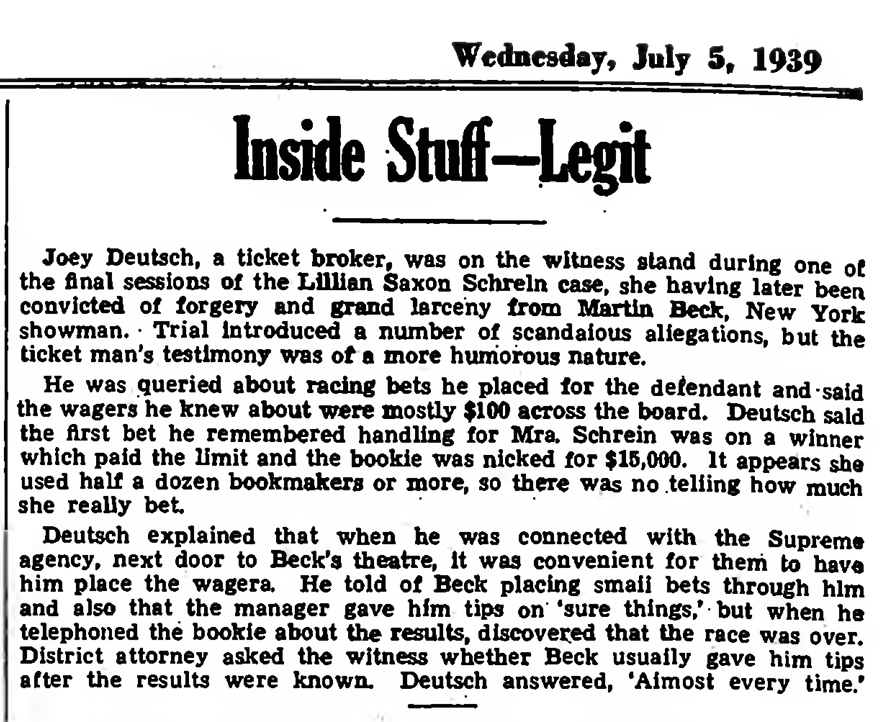
And this money had not been used for any theatrical venture. Instead, it had funded a lavish social life—cocktail parties, luxury goods, and expensive purchases from exclusive shops. Schrein even stole a $12,000 diamond ring belonging to Beck’s daughter. And initially, Schrein confessed to everything in writing, but later recanted, claiming the money was a gift.
Beck was summoned to testify and appeared in court frail and leaning on a cane. He testified that he never authorized those checks, and he also denied Schrein’s accusation of an affair as well. Ultimately, the jury found her guilty of grand larceny and forgery, and on July 10, 1939, she was sentenced to two to four years in a Women's State Prison. At the end, a courtroom official had this to say about Schrein:
“She is an egocentric and mercenary schemer. Her personality is a unique confusion of cleverness and conceit. She has an exaggerated idea about her ability. She is neither remorseful nor penitent.”

Beck’s financial loss was significant. But the personal betrayal—by someone so close to him, and so deeply embedded in the daily operation of his theater—was even more profound. Those closest to Beck would later say that the strain of the trial weighed heavily on him during the final year of his life. But the show must go on, and Beck didn’t step away. He was still at his desk—making decisions, shaping productions, and keeping a closer eye on the business he had built. Meanwhile, across town in 1940, Louise Beck joined a group of seven women that included Rachel Crothers and Antoinette Perry to start up the American Theater Wing as a way to help the war effort with its Stage Door Canteen.
That same year, Martin Beck brought a new musical into his theater called Cabin in the Sky, directed and choreographed by George Balanchine. Unlike many productions where Beck simply acted as landlord, this time he held a direct financial stake. It was a bold production, featuring an all-Black cast, and it opened to overwhelming artistic success—and it will be the subject of its own upcoming episode.

BECK’S WIFE & LEGACY
But on November 16, 1940, just three weeks after the musical opened, Martin Beck died at the age of 72 following complications from surgery, with his wife Louise at his bedside. And though his body was laid to rest a few days later, his theater would live on. The responsibility for everything Beck had established now passed into the hands of the person who had been closest to it all along.
But Louise Heims Beck didn’t just inherit a theater—she assumed control of an entire operation. For the next twenty-six years, through the Martin Beck Estate and working alongside Louis Lotito, she oversaw the theater and its day-to-day business. All while serving as Vice President of the American Theater Wing and eventually as its chairman.
Following the death of her close friend and co-founder Antoinette Perry in 1946, Louise was responsible for overseeing the organization and arrangement of the first ceremony in 1947 to honor Perry's memory and celebrate excellence in theater. That came to be known simply as The Tony Awards.

At the same time, she was deeply involved in the broader theatrical community as well, serving as a trustee of the Actors’ Fund and later as chairman of its executive committee, continuing her lifelong commitment to supporting the people behind the productions as much as the productions themselves. And all this work did not go unnoticed. In 1958, she was awarded a special Tony Award citation for distinguished service to the theater—a recognition not for a single production, but for decades of sustained influence on the industry itself.

By the mid-1960s, though, Louise decided it was time to step back from her leadership role at the theater. And so, for the final production presented under the Martin Beck Estate, Louise chose a unique play with a title almost as infamous as its content: The Persecution and Assassination of Marat as Performed by the Inmates of the Asylum of Charenton Under the Direction of the Marquis de Sade—better known simply as Marat/Sade.
Directed by Peter Brook, this 1965 production was raw, chaotic, and deeply unsettling. Actors remained in character as asylum patients throughout the performance—twitching, muttering, and reacting unpredictably—blurring the line between performer and audience. It was loud, physical, and at times deliberately uncomfortable.
And yet, it was a massive success—winning the Tony Award for Best Play. It was about as far as you could get from the polished operettas of Beck’s early years. But it proved that the theater he built—and she sustained—wasn’t frozen in time. It evolved with its audiences and shifts in the American theater landscape. It also made for quite a swan song, because three months after that production opened, and after more than four decades of Beck family ownership, Louise made the decision to sell the theater to William L. McKnight, head of Jujamcyn Theaters on February 16, 1966—marking the end of an era.
One that had seen variety acts and vaudeville make way for large-scale musicals and legitimate plays. Martin Beck showed Broadway what it could be. And in the process, he left behind a stage where the future of American theater could take shape.


“Closing Night is a production of WINMI Media, with me Patrick Oliver Jones as executive producer and host. Theme music is by Blake Stadnik, with Dan Delgado as co-producer and editor. And thanks to Christy Wurzbach Williamson for her voice talents. Be sure to join me next time as we discuss the milestones of the Martin Beck Theatre, including some notable flops and their journey to closing night.”
Sources and materials used to create this episode...
History and Background (Vaudeville, Orpheum, context)
Martin Beck (Biography and Career)
Beck Personal / Family
Theatre History (Martin Beck / Al Hirschfeld Theatre)
Landmark and Architecture Documentation
Palace Theatre and Beck’s Expansion
Houdini and Martin Beck
Obituaries and Primary Sources
Video Resources (General)
Opening Production: Madame Pompadour


Mình thỉnh thoảng cũng lướt mấy bài phân tích xổ số miền Bắc cho vui thôi, kiểu đọc để xem người ta suy luận thế nào chứ không đặt niềm tin tuyệt đối. Hồi trước toàn nghe bạn bè rỉ tai, bảo “cầu này ngon” rồi ghi theo, nhưng trượt vài lần liên tiếp nên mình bắt đầu để ý hơn tới thống kê và cách giải thích. Có bữa vô tình đọc một bài trên soicauxsmb.pro, mới thấy nhiều “cầu” thật ra chỉ là nhìn dữ liệu theo cảm giác, nên mình tự hạ kỳ vọng xuống. Từ đó mình coi chuyện này như giải trí nhẹ nhàng, có chọn thì chọn ít, thử vận may là chính. Mình…
Diving into this detailed analysis of Martin Beck's classic crime mysteries completely glued me to my screen this afternoon. The intense focus on tracking small clues reminded me of my own daily habit of closely watching minor shifts in the gold rate in pakistan for my family's savings.