


Tony-Winning Musicals at the Martin Beck Theatre

Transcript of a bonus episode exploring how Hallelujah Baby! and Grand Hotel became milestone productions at the Beck.
For almost 80 years, the Tony Awards have been the defining mark of Broadway excellence. But before them, a different prize was known as the Oscars of the New York theater scene and was honoring composers, designers, dancers, and even Broadway debuts. They were called the Donaldson Awards.
For decades, prestigious honors like the Pulitzer Prize and the Drama Critics’ Circle Awards had a monopoly on theater honors. But their small committees only decided which playwrights deserved recognition, while other creatives were largely ignored. And some years they refused to award anyone, believing that no writer was worthy enough.
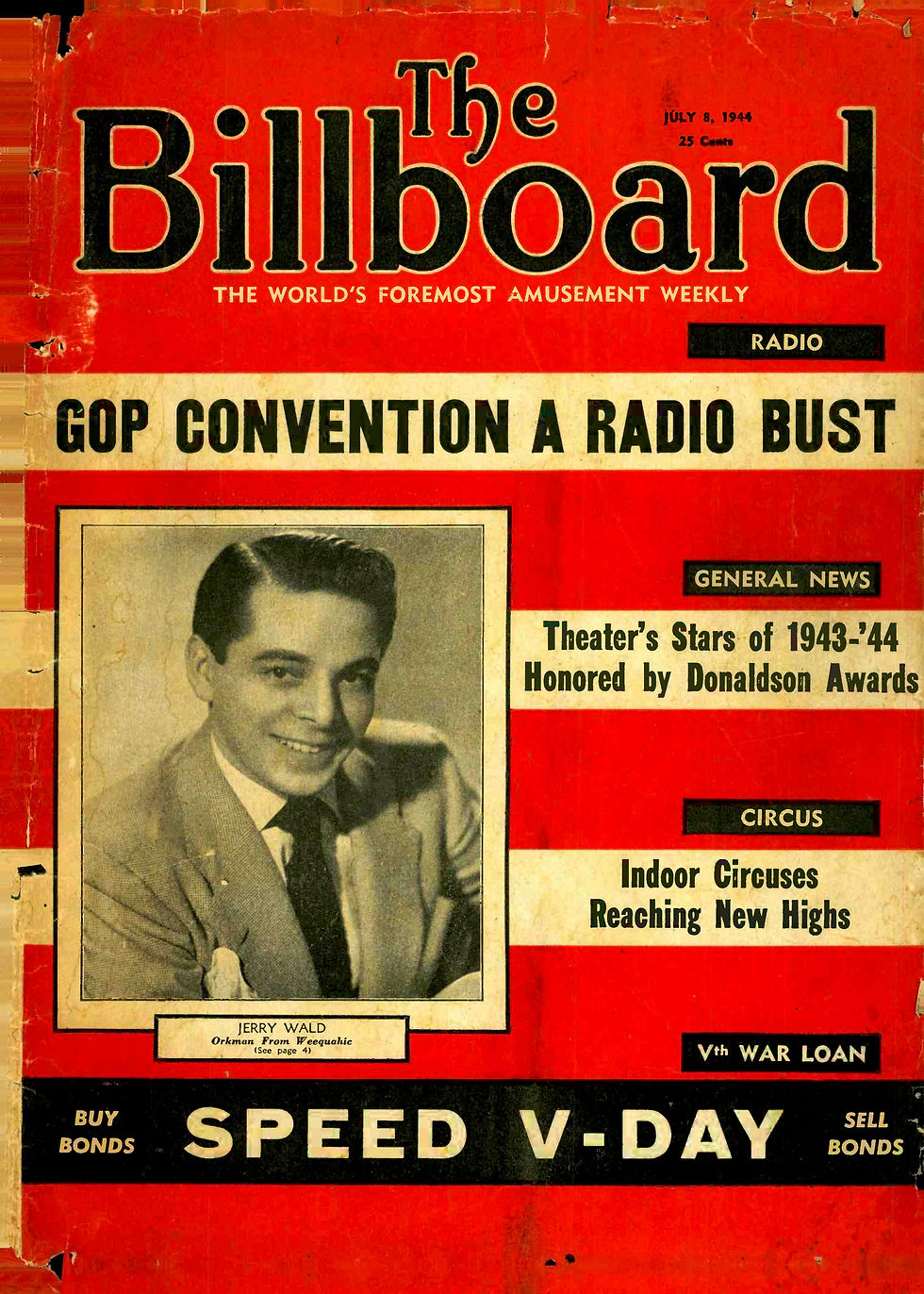
This didn’t sit well with Robert Francis—he was chief theater critic for The Billboard starting in 1942. You see, before it became known for its music charts, Billboard used to cover everything from radio and vaudeville to carnivals and Broadway. And Francis thought there should be a way to recognize all the creative and design artists that kept Broadway running. So in 1944, he launched the Donaldson Awards, named after the late Billboard owner, William H. Donaldson.
From day one, he rejected the idea of a small group of critics or academics controlling these awards. Instead, actors, stagehands, costumers, musicians, even ushers and more would vote on the best from each Broadway season. Also, these awards were the first to separate plays and musicals into their own categories. As Billboard proudly put it: “The Donaldson Awards were to be in every sense the theater's own recognition of its own.”

These awards quickly became a big annual event every summer, with Billboard and nationwide radio programs announcing the winners. And Beck Theatre productions were there from the start, with The Voice of the Turtle winning Best Play and Pearl Bailey earning Best Female Debut for St. Louis Woman. And for a few years, the Donaldsons stood as Broadway’s most visible theatrical honor.
But things changed in 1947 when the American Theatre Wing created the Antoinette Perry Awards. By honoring the late actress, director, and producer, these Tony Awards carried immediate emotional weight and prestige, and Broadway producers embraced them as a glamorous accomplishment. The first formal ceremony was organized by Martin Beck’s widow and one of the co-founders of the American Theatre Wing, Louise Heims Beck, who later became chairman of the Wing as well.
"We work constantly, we work very hard all year long. But our big party of the year and our final party is this Tony Award party, which we feel has become of increasing importance…to give the members of our own profession an award for what we consider a very distinguished work in the American Theater. I hope you all have a good time. Thank you.” ~ Louise Heims Beck at 1954 Tonys

For several years, the Tonys and Donaldsons existed side by side—and often honored the same productions. Most notable were two at the Beck that won back-to-back Best Play honors: The Crucible in 1953 and The Teahouse of the August Moon in 1954. And yet, differences between the two systems remained.
Unlike the Donaldsons, the Tony Awards didn’t reveal eligible nominees and kept their voting pool small and exclusive. One of the most important distinctions, though, and why the Donaldsons should be remembered is that they had a more extensive range of categories. And as a result, they frequently honored those that the Tonys simply overlooked. Performers and creators like Marlon Brando, John Raitt, Deborah Kerr, and Lorenz Hart all received Donaldson Awards during their careers, yet never won a single Tony Award.

But gradually, the Tonys would adopt many innovations pioneered by the Donaldsons—like separating plays and musicals as well as leading and featured roles, while also including more people in the voting process. As a result, the Tony Awards came to be recognized by the industry as a whole as the ultimate symbol of achievement. At the same time, the Donaldson Awards were becoming unsustainable for Billboard. First, there was the enormous financial cost of printing, distributing, and counting almost 6,000 ballots each season.
But then Robert Francis announced he was leaving Billboard, and the awards lost their driving force. So the Donaldsons were quietly discontinued after the 1955 season. No final announcement. No last hurrah. The company simply shifted its focus toward popular music as rock ’n’ roll was transforming the entertainment industry, and launched the Billboard Hot 100 in 1958. Meanwhile, producers and theatergoers focused their attention on the Tony Awards, turning it into Broadway’s biggest night.


"Among the many productions that passed through the Martin Beck Theatre over the decades, some didn’t just entertain audiences—they became defining theater successes, recognized by the industry at the highest level. I’m Patrick Oliver Jones and you’re listening to Closing Night. In this bonus episode, we'll look at two Tony-winning musicals that reveal just how unusual and unpredictable the path to Broadway can be."
HALLELUJAH BABY!
When the Tonys began, the Best Play award was considered to be the most prestigious, and was often the final prize handed out at the ceremony. In fact, in the early 1950s, three different Martin Beck Theatre productions won that coveted prize. But by the next decade, musicals became these commercial and cultural sensations, as their scale and budgets grew exponentially compared to straight plays.
And once the Tonys had their first national television broadcast in 1967, from then on it was the Best Musical award that would take centerstage. But away from the glitz of televised musical awards of that time, the physical stages of Broadway remained deeply entangled with the raw, political realities of the Civil Rights Movement.

Throughout the 1950s and 60s, the Martin Beck Theatre maintained a reputation for thought-provoking productions. And in 1967, it offered two contrasting versions of a divided country. A Delicate Balance by Edward Albee explored the emptiness and complacency of white suburban life, and it closed in January of that year. Just a few months later, Arthur Laurents brought Hallelujah Baby! to the stage, depicting Black Americans actively fighting, marching, and singing through the historical struggles they faced. And at the center of the musical was Georgina—a talented and courageous Black woman who is determined to build a career in show business as she fights against the barriers of racism and segregation. But the musical had an unusual concept: even though several decades of time would pass by, none of the characters would age.

To play this unique leading character, who travels and sings through various moments in history, Arthur Laurents had only one person in mind: Lena Horne. She got her start as a singer during the Harlem Renaissance and became a star on film, television, and of course Broadway—where she made Jamaica a hit musical in 1957 and earned herself a Tony nomination. So with Hallelujah Baby marking Horne’s return to Broadway, Laurents reached out to Gypsy composer Jule Styne, who he enjoyed working with and thought very highly of:
“Jule Styne had melodies pouring out of his fingers. He put his hands on a piano and there was a tune you couldn’t forget.”
Styne then brought in Betty Comden and Adolph Green—the lyrical team from his Tony-nominated musicals Bells Are Ringing and Do Re Mi. All four of these creatives were close friends with Horne and began shaping the musical to showcase her enormous talent and star power.

Now, we’re here in 2026, looking back 60 years at a musical about Black history that was written—and also directed and choreographed—by a white creative team. Today, a project like this would almost certainly involve a far more diverse group of people behind the table. But in the 1960s, these four affluent, Jewish-American theater artists believed their progressive ideals and immense theatrical talents could leverage the power of Broadway to support the ongoing Civil Rights movement by taking an edgy, visceral look at the Black experience.
After securing investors and the Beck Theatre, though, the team presented their show to Lena Horne. And despite their noble intentions, Horne felt the script lacked a truly authentic Black perspective and pulled out of the production. It was a definite blow to the team, but rather than end the production, they decided to find another actress to lead the show.

For years, Leslie Uggams had been a featured vocalist on the hugely popular television series Sing Along with Mitch. At a time when very few Black performers regularly appeared on prime-time television, millions of white Americans recognized her face and voice. So even though she’d never been on Broadway before, producers believed her television popularity could help sell Hallelujah Baby! to mainstream audiences.
But even with her TV credits, she still had to audition to show she could realistically perform through various musical styles and time periods. Fortunately for Uggams, she had been well-trained at Juilliard, so when she went in to audition, her vocal abilities proved she could do handle the role. In Uggams' own words: "It wasn't handed to me. I had to audition and finally, I guess I passed muster." However, Uggams was 25 years younger and had a very different personality from Horne. This presented a problem for Laurents:
“Leslie Uggams was one of the sweetest women in the world, but Lena was a tiger with an edge, and Leslie was very sweet and adorable, so it was a different show.”

For his new leading lady, Laurents made the decision to completely rewrite the DNA of the show and lean into her youth. The character of Georgina would pivot away from a fierce, battle-hardened survivor pushing through racism toward a lighter, bright-eyed optimist climbing her way through history. For the young Uggams, this was exciting and overwhelming all at the same time.
“That was an incredible experience. Working with Jule Styne, Comden and Green is a gift, a real gift. And of course Arthur was another gift. I didn't realize how fortunate and incredible this experience was, You know, looking back I go, Oh my goodness, I've got to work with these people. I had never done Broadway, you know, things that people dream about, and here I was working with these people, and it was just wonderful.” ~Leslie Uggams

Even as Laurents kept reshaping the material around Uggams, the atmosphere in rehearsals remained a relaxed and even joyous experience—thanks to director Burt Shevelove, who was smart, soft-spoken, and deeply collaborative with his company. At one point early on, the production needed a replacement rehearsal pianist. So they hired a young, unknown, aspiring songwriter named Marvin Hamlisch. On his first day, he sat at the piano and played Styne’s complex, period-hopping score perfectly on the first try. The creative team was blow away by his skills, and Hamlisch’s brilliance in those rehearsals directly helped launch his own historic career.
From there the company moved onto dancing, led by choreographer Kevin Carlisle, who leaned heavily into the talents of his featured dancers. When the company would cut loose on numbers like the title track "Hallelujah, Baby!" the sheer volume of synchronized stomping and vocal energy would literally shake the rehearsal hall floors.
Once the creative team crafted the show for Uggams, the script's political bite had softened, and the score shifted into a lighter, more bubbly musical comedy. Uggams was a good actress with a beautiful voice, but according to Laurents, the show had now lost its edge—and with it, his interest. That became readily apparent when the show opened on April 26, 1967. Critics praised the score and hailed Uggams as a star, but sharply criticized the writing. Walter Kerr of the New York Times found the script too simplistic in its approach to race relations:

“Mr. Laurents, alas, has had one of those days when inspiration won't come. He simply puts down what we all know, even more simply than we know it, practically on the level of those grade-school readers … There are no real tries for wit in lyrics or libretto, and the wisdom, I'm afraid, is old-fashioned platitudinizing … Something about the show coils back in on itself, turning progress into a kind of naiveté. Considerable craftsmanship has been spent on a once-advanced stance that is now uncomfortably out of date.”

Overall white theatergoers found the script too preachy, while Black audiences felt it was sanitized and out of touch. The star power of Uggams did keep the show running, though, for about nine months. One notable replacement was a young Billy Dee Williams just a few years before his Hollywood stardom. He took over the role of Clem—Georgina’s conflicted love interest. But ultimately, the box office dried up and Hallelujah Baby! closed at a financial loss on January 13, 1968, after 293 performances. However, three months later the show unexpectedly received nine Tony nominations, recognizing actors, designers, and the entire creative team—except for Laurents.

“The show was I think ahead of its time, had a lot of things to say. Poor Arthur got criticized for the book very, very harshly. I think more harshly than he really deserved, and it was really kind of sad when all of us got nominated for Tonys, and the book wasn't, you know. And they closed the show, and we win all these Tonys and we were closed … and the show was not running, which was really a sad situation, because it was a wonderful show.” ~Leslie Uggams
By the end of the evening Hallelujah, Baby! led all productions with five wins, including Best Musical—giving it an unusual distinction in Broadway history as the only show to ever win that award after having already closed. But the history-making didn’t stop there. Betty Comden, alongside fellow lyricist Adolph Green and composer Jule Styne, won the Tony Award for Best Original Score—making Comden the first woman to ever win in that category.

“Thank you very much. We're very happy to get this award for this show, which was supposed to be controversial. It was a joy to write, even though it was very hard to get it on. But we're very happy. Thank you.” ~Betty Comden
And there was another rare event that night. Not only did Uggams win Best Actress in a Musical but she shared the award with British actress Patricia Routledge for her performance in Darling of the Day—it’s only the third time in Tony history that a tie like this has ever happened.
UGGAMS: Wow! I don't know where my feet are right now…I just want to thank everybody from the Hallelujah Baby cast. And most of all, Comden and Green, Jule Styne and Arthur Laurents, who made everything possible.
ROUTLEDGE: I just want to say that you did me a very great honor inviting me over here to be in a musical, and you do me a great honor now, and I'm delighted to share it with you. Thank you.

And one final milestone from the 1968 Tonys, when Uggams won Best Actress and her co-star Lillian Hayman won Best Featured Actress, it marked the first time two Black women won competitive awards in the same year. So while the show itself may not have furthered the Civil Rights Movement in the way the writers hoped, it still left its mark on Broadway and the Tony Awards. After the break, we'll discuss one of the longest-running musicals to ever play at the Beck Theatre.
GRAND HOTEL
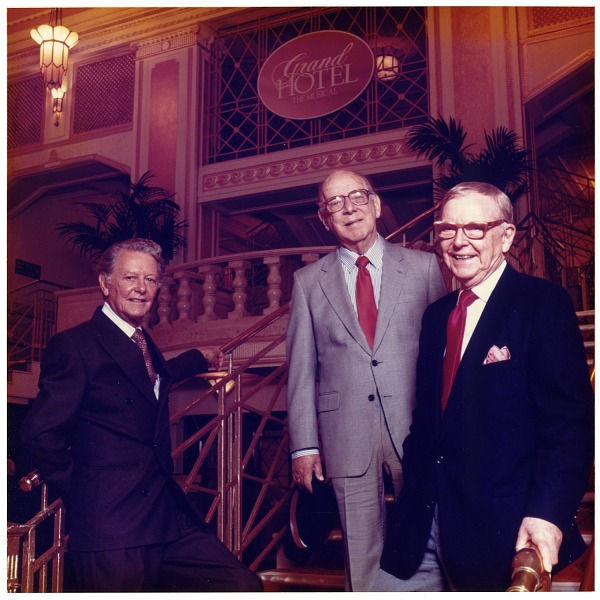
The musical writing team of Robert Wright and George Forrest made their Broadway debut in 1944 with Song of Norway. But it wasn’t until a decade later that they got their first Tony nomination and win for Best Musical with Kismet. It starred the incomparable Alfred Drake and ran for almost a year and a half. As a follow up, they adapted a popular 1929 novel People in a Hotel by Austrian novelist Vicki Baum. It had already been turned into a successful play and Oscar-winning film, so it seemed the perfect vehicle for a musical as well.
The story unfolds at an elegant hotel in Berlin during the Roaring Twenties, where the lives of seven eccentric guests unfold in unexpected ways. And Kismet’s co-book writer, Luther Davis, was tasked with transforming the novel into a script. He would change the setting to 1950s Rome and the title to At the Grand. The Oscar and Tony-winning actor Paul Muni was brought in to play the lead, as characters were added and cut and the storyline significantly altered.

However, Muni was 62 years old and had been struggling with severe health problems, including a rheumatic heart and a tumor that led to the removal of his left eye—with a glass eye put in its place. When At the Grand headed out of town for tryouts in Los Angeles and San Francisco, audiences seemed to love it and box office sales did very well. But the critics noted its structural problems and complained about the haphazard changes to the original story. All the while it was becoming painfully clear to the creative team that Muni's health would not allow him to endure the grueling, long-term schedule of a Broadway run.
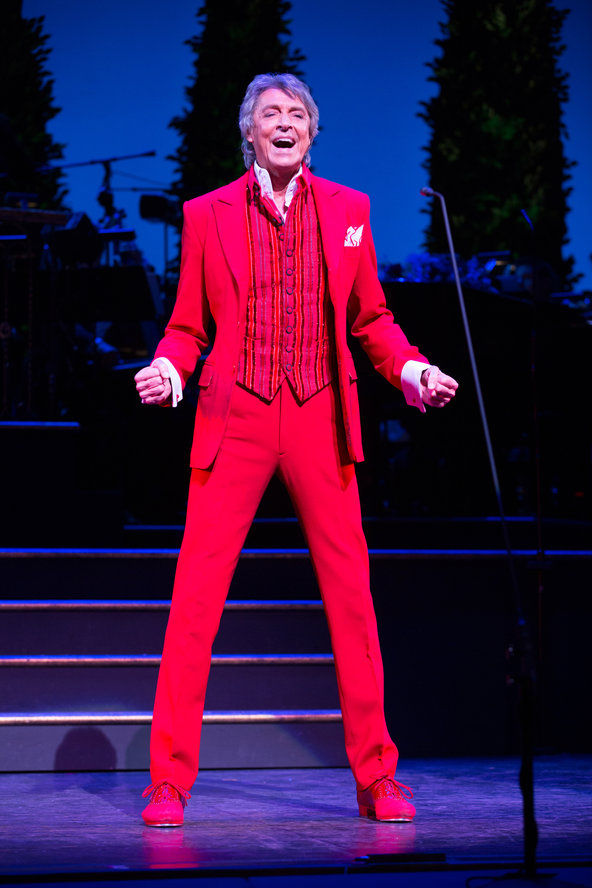
So with an ailing leading man and a show in need of fixing, the producers decided to cut their losses and cancel the Broadway run. Luther Davis went back to TV and film, while Wright and Forrest kept creating music for the stage and screen. But by the late 1970s, they'd all settled into a quiet retirement. That was until a director-choreographer named Tommy Tune took an interest in the original 1929 novel and approached them about reviving their old musical.
After three decades, Davis, Wright, and Forrest saw this as a chance to dust off their old show. Producers offered them a fresh workshop to work on it, led by the Tony-winning Tune, who envisioned it as a continuous show from beginning to end with scenes, musical numbers, and dance routines that would at times overlap each other. It was also decided to change the setting back to Berlin as well as bring the characters back to the their original design.

Tune brought together a cast of 35 performers, including veterans of the stage like David Carroll, Karen Akers, and Michael Jeter alongside future stars Jane Krakowski and Mark Jacoby. And as the show developed and evolved, Tune’s “guiding force” was that original 1929 novel, as Krakowski explains:
“It was such an unusual thing to work on, because when I had gotten the role, there was no script. I got the job and Tommy handed me a six hundred page novel and said, 'This is our Bible. This is what we're using.' And the workshop was an incredibly creative time because we got to spend a lot of time on just working out the scenes between the actors and putting the book to life.”
Seven songs from At the Grand were incorporated into what was now called Grand Hotel. And at one of the early run-throughs, Maury Yeston was there—he had worked with Tune on the musical Nine—and in an interview for Playbill he said that it was hard to understand what little plot there was. There wasn’t even an opening number. And it had all these character songs, but they didn’t define the characters nor fit with the story. Yeston went on to say: "It was missing all kinds of parts…Nobody knew what was going on.”

“There were many changes and I think the the show resulted in the best form because of it...It's truly an ensemble piece. Every actor. They're all just so good that you want to be as good as they are every night...you don't want to let the other guy down. So we all we all really pitch in our part. “ ~ Jane Krakowski

After a series of workshops and rehearsals, the company headed to Boston in August 1989 for a three-week try-out at the Colonial Theatre. But it was clear the show still wasn’t working, so Tune called up two friends to come help. Peter Stone worked with Davis to revise the book, and Maury Yeston came in to help with music and lyrics, and he describes his first meeting with Wright and Forrest:
“So I sat down for lunch with them, and they were both in their mid-80s. And I said, ‘Gentlemen, I'm in awe of obviously everything that you've done, and I want you to know I think it's everybody's worst dream: the idea that, you know, you're having a show, and you're having some difficulties, and there's another writer in town. I just want you to know I'm only here to give you the best advice I possibly can.’ And Wright turned to Forrest and said, ‘Oh look how young he is. Doesn't he remind you of us when we first met Cole Porter?’"
So from the start, it was a congenial partnership, and Yeston did his best to maintain as much of the original score by Wright and Forrest. But when songs were incomplete or detached from the story, then he had to weave in bits of his own composition to flesh it out. Some songs, though, had to be written completely from scratch, like “Love Can’t Happen.” There was a scene with the Baron—played by David Carroll—and Tune wanted him to sing after he was shot for stealing a wallet. But to Yeston, that didn’t make any sense:

“And Tune said, 'Well, he's got to have a song.' And I said, ‘Well, he's dead.’ He said, ‘Yeah, but he's the star of the show. He's got to have a song.’ I said, ‘Yes, but he's dead. ‘And he said, ‘Yeah.’ And I hadn't slept in two weeks. And this was a really important moment. And I was walking around the corner, and I was really feeling suicidal. I said, ‘You know, this is impossible. You know, I might as well just jump off a bridge somewhere.’ And then I thought, 'Well, wait a minute. When you die, isn't your life supposed to flash by your eyes?' What if he runs forward in his tuxedo and imagines after he's shot, that he's got to the station with the roses, he's going to meet the ballerina, and ... his whole life flashes before his eyes in song. And as he's singing this song, his white shirt is turning red. And I wrote it, and we did it, and it worked.”
Well, after thirty-one previews and a lot of fine-tuning, Grand Hotel made its Broadway opening on November 12, 1989 and quickly became one of the most talked-about musicals of the season—especially for a high-energy Charleston number called “We'll Take a Glass Together” that featured a very limber Michael Jeter.
But it was actually one of the more challenging numbers for Tune to choreograph. You see, throughout the rehearsal process, every week he’d go back to Texas to visit his mother, who was slowly dying of cancer. He would tell her all about the scenes and dances he was staging as well as this one particular number that just wasn’t working, and he couldn’t figure out why.

“So I went to Houston that Saturday night, and on Sunday, she said, so tell me, where is it now? Where is it now? I said, well, the little bookkeeper is dying … and he just got a windfall on the stock market. So that means he's going to spend his last days in the Grand Hotel. And he does this German tap dance. And, mother, it's just awful. It's just awful … And she said, well, now, what year is this? I said, It's 1929. She said, oh, sounds like it ought to be a Charleston. I said, mother, you're absolutely right. Of course it should be a Charleston … And I got up and I started showing her all the steps. And I remember, she said, well, do you remember the one that goes like. And I wasn't doing it. And she got up and she was quite weak, and she got up off the edge of the bed, pushed herself up and did this step. So, yes, she helped me choreograph it.”

At the Tony Awards in June of 1990, Grand Hotel led the way with 12 nominations, and would go on to win five of them, including Best Direction and Best Choreography going to Tommy Tune. Even though City of Angels would ultimately win Best Musical, Grand Hotel proved itself to be a critical and commercial success. And through its long run, there were several notable replacements, including Chip Zien, John Schneider, and Austin Pendleton. But the biggest of all was legendary MGM film star Cyd Charisse, who made her long-awaited and only Broadway debut in December 1991. Her presence is credited with boosting the show's box office late in its run—which lasted more than two years at the Beck, before transferring to the Gershwin Theatre in February of 1992.

A month later, the original cast was brought together to do the cast recording, including lead actor David Carroll. Unfortunately, he had been seriously ill with AIDS and suffered a fatal pulmonary embolism at the recording studio before he was able to record vocals for the Baron. Understudy Brent Barrett stepped in to record the role. As a tribute, on the cast album they included a bonus track of Carroll performing “Love Can’t Happen” at a cabaret fundraiser.
As we finish up, I have to mention the masterful lighting designer Jules Fisher, who took home the Tony for Best Lighting Design, creating the ambiance and shadows and moods of Grand Hotel. He would go on to win the following year for Will Rogers Follies and again in 1992 for Jelly’s Last Jam, making him the only designer, lighting or otherwise, to ever win three consecutive Tonys.

So it is no surprise that this year at the 79th Annual Tony Awards, he will be receiving a Lifetime Achievement Award honoring his six decades of work on Broadway. His job is rather straightforward—to light a stage—but as he explains, it’s all in how you do it.
“The lighting designer in a Broadway theater is to take advantage of light, to manipulate light, so that you understand the play, to tell the story, to communicate, to make believable, to make you aware of awe and wonder, and to communicate about emotions, to make you feel something. And the lighting designer manipulates light to do all that.” ~Jules Fisher
Fisher’s career has spanned more than 300 productions, capturing a record-breaking 24 Tony nominations and 9 wins for lighting design. His designs have become the foundational DNA of modern Broadway, having illuminated the original productions of Hair, Jesus Christ Superstar, Pippin, Chicago, and Angels in America.

Outside the theater world, Fisher has lived a double life as a rock-and-roll pioneer as well. He served as the production supervisor and designer for massive, arena-defining concert tours ranging from the Rolling Stones, KISS and The Who, to David Bowie, Whitney Houston and Barbra Streisand. And he used his various stage sensibilities and put them into musical films like The Rose, The Producers, Dreamgirls, and Enchanted.
Throughout his career Jules Fisher has taught Broadway how to think cinematically, taking an invisible medium and turning it into the psychological heartbeat of a show like Grand Hotel—which firmly established itself as one of the most visually ambitious and celebrated musicals to ever play at the Martin Beck Theatre.

Closing Night is a production of WINMI Media, with Patrick Oliver Jones as executive producer and host. Theme music is by Blake Stadnik, with Dan Delgado as co-producer and editor. Be sure to join me next time as another show makes it way to closing night.
Sources and materials used to create this episode...
TONY AWARDS
DONALDSON AWARDS
History - https://www.worldradiohistory.com/Archive-All-Music/Billboard/50s/1952/Billboard%201952-06-21.pdf
1952: https://www.worldradiohistory.com/Archive-All-Music/Billboard/50s/1952/Billboard%201952-06-21.pdf
1955: https://www.worldradiohistory.com/Archive-All-Music/Billboard/50s/1955/Billboard%201955-07-09.pdf
HALLELUJAH BABY!
https://www.ibdb.com/broadway-production/hallelujah-baby-2940
https://playbill.com/article/revisit-leslie-uggams-in-the-tony-winning-hallelujah-baby
Lena Horne: https://stagecoachplayers.com/lena-horne-the-lady-and-her-music/
2002: https://archive.ph/20120722075402/http://www.broadwaytalk.com/regional/nj/nj65.html
Tony Awards Performance: https://www.youtube.com/watch?v=544qT0JqAtY
Arthur Laurents
Leslie Uggams
GRAND HOTEL


Tony-winning musicals at the Martin Beck theater heaven. As a PhD student who works part-time at Last-Minute Assignments, I've seen a couple and cried every time. I was so moved that I'd think, Just do my engineering assignment so I can go more. Your post is a celebration of Broadway. Thank you for that. Shows, stars, magic. Grateful for the memory. Keep the arts alive. Seriously, my soul needs this. Here's to standing ovations. Thanks for the share. Cheers.